Thứ Bảy, 17 tháng 1, 2015

Thị trường điều hòa cuối năm

Lượng bán ra hàng trăm bộ/ngày

Riêng đối với Siêu thị điều hoà VinaCore của Công ty Cổ phần Xây dựng và Kỹ thuật lạnh Việt Nam (VinaCore Group), những ngày nắng nóng này, lượng dieu hoa bán ra lên tới 200 - 300 bộ/ngày, thậm chí những ngày cao điểm còn lên tới 500 bộ/ngày.
“Với lượng hàng bán ra quá lớn mỗi ngày nên vấn đề nan giải nhất đối với công ty hiện nay vẫn là lắp đặt”, ông Nguyễn Cảnh Ngọc, Phụ trách Kinh doanh của VinaCore Group chia sẻ.

Hiện đội ngũ lắp đặt của công ty này lên tới gần 60 người, nhưng vẫn không đủ để cung cấp cho thị trường vì phải kết hợp với làm công trình.

Do vậy, để giải quyết vấn đề này công ty buộc phải đưa ra hai hình thức hình thức hỗ trợ cho khách hàng. Hình thức thứ nhất là bán lẻ với giá bán buôn, trừ tiền cho những khách hàng mua sản phẩm nhưng không yêu cầu lắp đặt. Đối với hình thức này, số tiền khách hàng có thể tiết kiệm lên tới 200.000 - 500.000 đồng tùy loại máy.

Hình thức thứ hai, VinaCore khuyến khích những khách hàng lấy máy và hẹn trước thời gian lắp đặt dieu hoa funiki, khi đó khách hàng sẽ được trừ thẳng vào giá bán từ 100.000 – 200.000 đồng/bộ (tuỳ theo thời gian hẹn).

Mặc dù, khá khó chịu với sự nắng nóng của thời tiết nhưng trong tình hình hiện nay, nhiều khách hàng cũng vẫn phải chấp nhận phương án chờ để có được sản phẩm ưng ý và chất lượng lắp đặt đảm bảo.

Anh Công Minh (Mê Linh – Hà Nội) cho biết để có được chiếc dieu hoa lg ưng ý anh đã phải đặt trước cả tuần mới có hàng và người lắp đặt.
Thị trường điều hòa cuối năm


Tuy đã được phía siêu thị thông báo do người mua hàng khá nhiều và đặt hàng trước, nhưng chị Kim Thu (Thành Công – Hà Nội) vẫn khá sốt sắng vì 2 ngày rồi mà chiếc điều hoà Panasonic tiết kiệm năng lượng mà gia đình chị đã chọn mua vẫn chưa được giao hàng và lắp đặt.

Lượng khách có nhu cầu mua điều hoà tăng đột biến cũng đã khiến giá bán lẻ của nhiều sản phẩm chỉ trong vòng chưa đầy 1 tuần đã tăng thêm từ 100.000 – 300.000 đồng/bộ.

Song, theo ông Cảnh Ngọc, thời điểm này vẫn chưa phải là “đỉnh” của mùa điều hoà. Hiện nguồn hàng khá dồi dào do các tổng đại lý vừa nhập hàng để chuẩn bị cho mùa nóng và tình trạng “găm” hàng vẫn chưa diễn ra.

Nhưng đến cuối tháng 5, đầu tháng 6, giá bán có một số loại điều hoà có thể sẽ tăng lên từ vài trăm nghìn tới trên 1 triệu đồng/bộ so với bây giờ. Năm trước vào giai đoạn cao điểm của nắng nóng, người tiêu dùng chấp nhận giá cao cũng không mua được do phần lớn các “đầu nậu” muốn găm hàng lại để đẩy giá lên mặt bằng mới.

Do đó, lời khuyên đối với người tiêu dùng vẫn là nên mua khi thị trường chưa “sốt” để có mức giá hợp lý, chất lượng lắp đặt đảm bảo do thợ không phải chạy “sô” vì số lượng đơn hàng quá lớn.

Hai xu hướng cùng song hành

Về xu hướng lựa chọn điều hoà trong năm nay, hiện đang có hai xu thế rất rõ rệt dù đối ngược nhau đó là “chuộng” cả điều hoà cao cấp tiết kiệm điện (tích hợp công nghệ biến tần inverter) và điều hoà giá rẻ với những tính năng cơ bản.

Ông Ngọc cho rằng việc có hai xu thế đối nghịch cùng tồn tại song song là điều hợp lý trong giai đoạn này. Yếu tố đầu tiên tác động tới quyết định mua của người tiêu dùng chính là lạm phát, chỉ số giá không ngừng tăng cao trong thời gian qua. Điều này khiến người tiêu dùng phải cân nhắc hơn trong các khoản chi tiêu. Vì vậy, một bộ phận có xu hướng mua điều hòa cơ bản, giá rẻ để giải quyết tạm nhu cầu giải nhiệt trong mùa nóng.

Nhưng lại có yếu tố tác động thứ hai tác động đến xu hướng mua điều hòa khác là giá điện. Giá điện tăng cao và dự báo tiếp tục tăng khiến đại đa số người mua điều hòa phải cân nhắc trước khi quyết định. Hiện điều hòa không khí vẫn là vật dụng “ngốn” điện nhất trong mỗi gia đình. Với một gia đình việc sở hữu từ 2 - 3 máy điều hòa trong nhà sẽ tiêu tốn tiền điện lên tới trên cả triệu đồng/tháng và đó là gánh nặng tài chính khá lớn trong mùa bão giá.

Thứ Tư, 14 tháng 1, 2015

My Tho travel guide

Buses coming southwest of bustling Ho Chi Minh City rise from the urban sprawl into the verdant fields of the Mekong’s plains. The Delta’s shy demeanor teases by only giving glimpses of its raw beauty through the lush rice fields with their golden skin interspersed with a splendid green tinge. 70km out of Ho Chi Minh City is My Tho, a quaint and charming town that lies on the northern bank of the Mekong River, the Tien Giang.

My Tho’s close proximity to Ho Chi Minh City translates into a lion’s share of day trippers visiting the Mekong Delta. The large number of day trippers to My Tho has developed pushy vendors that crowd around tour buses that arrive. Nonetheless, the town is a welcome relief from the hustle and bustle of Ho Chi Minh City. Enjoy the un-crowded boulevards, wander the backstreets, and explore the town by boat to experience all that My Tho has to offer.
A recommended stop is Thai Son Island, where the local villagers have a thriving business cultivating bonsai trees. The island is filled with varieties of fruit trees and plants. Travel to Vietnam
My Tho travel guide
My Tho travel guide

Distance: 75km from HCMC.
Access by car / bus: 2hr

Vinh Trang Pagoda

The pagoda is a beautiful and well-maintained sanctuary. The charitable monks here provide a home to orphans, disabled and other needy children. The pagoda is about 1km from the city center.

Distance: centre of town.
Access by car / bus: 15min
Entrance fees: no

Thoi Son Islands

This is the highlight of a visit to My Tho including sampan cruise through the maze of small canals and visit to local friendly families and tasting fruits in orchid gardens.

Dong Tam Snake Breeding Farm

Dong Tam is the centre of snake breeding for taking venom for exportation, as well as medicinal plant cultivation and the study and treatment of snakebites, for people in the Cuu Long River Delta. There is a snake-breeding zone with dozens of species to feed or even to play with. There are also crocodiles and other species of birds and animals on hand.

Distance: 9km from My Tho town.
Access by car / bus: 30min

Thứ Tư, 7 tháng 1, 2015

Traditional attire of the Brau people

Living in the culture-rich Central Highlands, the Brau people have formed their unique customs and culture, including traditional attire.
Like other ethnic groups in the Central Highlands, the Brau’s traditional costumes are handmade and sophisticated. Previously their clothes were simply for protecting human bodies and agricultural production. Thao Loi, head of the Dak Me hamlet in Bo Y commune, Ngoc Hoi district, Kon Tum province, said: “In the past the Brau people weaved clothes from the barks of trees. The bark was smashed, squeezed and boiled before being used for weaving. Now we no longer use this material.”
Traditionally, a Brau man wore a loin-cloth without a shirt on. A woman wore a ragged skirt. In summer, both men and women were half-naked or wore short tunics. In winter, they covered their bodies with a soft sheet of cloth. As time went by these clothes have been modified. Now men wear a tunic in a square shape. The front flap is of a bight color with dark stripes on the shoulders and fringe. The tunic’s back is marked with horizontal stripes on the lower part. Female attire is more elaborate with patterns. Nguyen Phong, a researcher of Central Highlanders’ costumes, told VOV: “The designs differ between male and female clothes. Men’s designs are rugged with such shapes as arrows and fences while women’s designs are flowers and plants, with accessories in agate and bead”.  Centre Vietnam tours
Traditional attire of the Brau people

In general, today’s clothes of the Brau are not colorful and complicated, but simple and natural. In their traditional attire, men look strong and fierce with their exposed muscles and women become more graceful and lissome. Their typical ornaments are feather, elephant’s tusk and metal items. The Brau women wear many necklaces, bracelets and anklets because they think that more they wear the more they attract men. Some anklets produce interesting sounds. Mekong with transfer to Phu Quoc Island
Dang Hung from Kom Tum province’s Council of Ethnicity said: “There is a State-funded project to revive the brocade weaving among the Brau ethnic people. Locals used to buy cloth from Laos, but now they weave cloth themselves. The project helps open 4 training courses on brocade weaving for local women”. Jasmine Cruise – Halong Bay
Traditional Brau clothes beautify its wearers and contain distinctive cultural feature of an ethnic group in Vietnam’s Central Highlands

Thứ Sáu, 2 tháng 1, 2015

About Huong Hai Ha Long

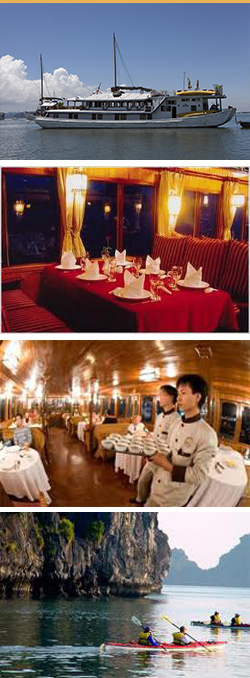
For more than 10 years in serving and hosting international guests on the tranquil waters of the bay, we do set a well-known, leading and stable standard of the best quality service for Ha Long Bay cruise trip from mid-range to high-range customer. The first and biggest company to offer overnight cruises on the bay,
Huong Hai understands customers’ desire and we built the first  traditional style wooden boat with deluxe deluxe cabins and facilities. As a result, nearly half of 1 million people have joined Huong Hai Junks on magical, enlightening journeys through Ha Long Bay,  Huong Hai cruise.

Beside the wooden traditional boat fleet with 6 boats named Huong Hai Junks, Huong Hai Ha Long proudly to grand open new luxury cruise named Huong Hai Sealife Cruises. The new boat inherits the experience of cruise service over the years and set a new standard of luxury cruising.

Grand Halong hotel on Halong bay Travelling Tour

About Huong Hai Ha Long

The first responsibility is to passengers and partners. Its products and services must always be of the best quality in 3-star standard. And bookings must be promptly attended too. Its trade channels buyers must make a fair profit.

Lost in the maze of Halong Bay caves


The second responsibility is to those who work with us, they must have a sense of security in their jobs. Wages must be fair and adequate. Management is just, hours reasonable and working condition nurturing. Captains & Supervisors are qualified and fair minded. Each crew member must be considered an individual, standing on his own dignity & merit.

The third responsibility is to Management. Our executive must be person of talent, education, experience and ability. They must possess common sense and full understanding.
The fourth responsibility is to the local communities and authorities. We will support environmental friendly project and local charity. We promote civic improvements, health, education, invest back into the local communities and make them part of the development of responsible Tourism.

Thứ Tư, 24 tháng 12, 2014

Halong most famous cuisines

Sea snalis – a half of Ha Long’s cuisine
It might be a little overstated to say that half of Ha Long cuisines are dishes made from sea snails, but this is to emphasize the significant contribution of this irresistible food stuff to Ha Long gastronomy.
There is no precise estimation on how many types of sea snails are edible in this beautiful bay. Huan, a local fisher said that he had seen about 20 kinds of see snails so far. The fisherman continued his story about sea snails by listing their name respectively, however, after three repeating times, this unprofessional tour-guide decided to try out directly that extraordinary creature would be the best way to “taste” Ha Long.
Halong most famous cuisines

Halong Sea Snails - Try it and love it
Cao Xanh market and Bai Chay market are the most popular spots where sea snails are supposed to be sold with the best quality. Wandering around Bai Chay, which is crowded with people eating on the sidewalks, every one can see a panel with the title: “Ha Long snail super market” that excitingly catches visitors’ eyes. Having a look through the restaurants’ menus, visitors would surely be surprised at the diversity of sea snails here.
With only one bowl of sauce made from fish-sauce, ginger, peppers and lemongrass, each type of snails with different unique flavors and different ways to enjoy would make anyone's mouth water. Eaters enjoying snails are advised to drink hard beverages such as alcohol to avoid stomachache.
The other half of Halong’s cuisines: seafood derivatives. halong bay cruises
Visitors must be excited when served special liquor named “Ngán - Arca Wine” (“Ngán” is a species of Veneridae). This special drink is actually a mixture of typically Vietnamese rice wine and “Ngán” blood, which is supposed to benefit men’s sexual ability. After the mixture is completed, the wine transforms into a light red color with totally a different flavor. Spirit followers cannot wait to drink it, to feel an immediate absorbent into their bodies.
Halong Seafood
Ngan or Arca to make the wine
Another well-known alcohol named “Hoanh Bo” should definitely not be missed when visiting Ha Long. With low volume of alcoholic, the liquor is not tough to conquer, yet some people who consumes too much Hoanh Bo need 2-3 days to sober.
Ha Long is also famous for squid-sausages, which is told to be delicious and fragrant only when processed by restaurants here. The food is a fusion of hashed squid and mysterious spices that only the chefs know, molded into round pieces and then fried in boiling oil. This special dish can be found anywhere along the shore from Quang Ninh to Hai Phong, but nowhere has the same level of deliciousness like in Ha Long.
Squid sausage
Squid sausage - Halong's most famous dish
The diversity of shrimps, from the luxurious one like lobsters to the other common shrimps, is another outstanding feature of cuisine in Ha Long. To many local people, a dish of streamed shrimps, served with lemonadized salt and a dish of freshly spicy vegetables, is an ideal meal for a joyful friendly union.

Thứ Tư, 17 tháng 12, 2014

Halong Bay Vietnam

Geographical position

Situated in the north-east region of Viet Nam, Halong Bay is a part of Bac Bo Gulf and comprises the sea area of Halong City, Cam Pha Town and a part of Van Don island district, Quang Ninh Province. It borders Cat Ba Island to the south-west, the mainland to the west with a 120km-long coastline.

Natural Beauty

Halong Bay covers a total area of 1,553km², including 1,969 islands of various sizes, 989 of which have been given names. There are two kinds, limestone and schist, which are concentrated in two main zones: the south-east (belonging to Bai Tu Long Bay) and the south-west (belonging to Halong Bay). The average geological age of the islands is between 250 and 280 million years old.  Halong bay tours

Halong Bay has been called by the great national poet Nguyen Trai: "a marvel of the earth erected towards the high skies". While exploring the bay, tourists will feel lost in a legendary world of stone islands which shapes change depending on the angle and the light. There are many names given to islands according to their shapes and forms such as Hon Dau Nguoi (Human Head Islet), Hon Rong (Dragon Islet), Hon Canh Buom (Sail Islet), Hon Trong Mai (Cock and Hen Islet)… But the beauty of Halong Bay does not consist only in the forms of its mountains, islands and the colour of its waters, but also in its infinitely rich system of grottoes and caves such as: Thien Cung (Heavenly Palace Grotto), Dau Go (Driftwood Grotto), Sung Sot (Surprise Grotto), Tam Cung (Three Palace Grotto), Trinh Nu (Virgin Grotto)…. Each is a grandiose and refined natural architectural creation.
Halong Bay Vietnam
Halong Bay Vietnam
 
Geological value

The most remarkable geological events of Halong Bay’s history in the last 1,000 years include the advance of the sea, the raising of the bay area and the strong erosion that has formed coral and pure blue and heavily-salted water. This process of erosion by sea water has deeply engraved the stone, contributing to its fantastic beauty. Present-day Halong Bay is the result of this long process of geological evolution that has been influenced by so many factors. It is because of all these factors that the tourists now visiting Halong Bay are not only treated to one of the true wonders of the world, but also to a precious geological museum that has been naturally preserved in the open air for the last 300 million years.

Value of biological diversity

Results of scientific research show that Halong Bay features ecosystems of a tropical ocean region such as ecosystem of coral reefs with 232 species of coral distributed mainly in the areas of Cong Do and Bo Hung. It is also home to 81 species of gastropoda, 130 species of bivalvia, 55 species of polycheta and 57 species of crab. The ecosystem of salt water-flooded forests chiefly concentrated in the zones of Tuan Chau, Cua Luc and Ba Che has the most diversified collection of species of salt water-flooded plant in North Vietnam. Also living in this ecosystem are a great many species of animals: migrating birds (200 species), polycheta (169 species), seaweed (91 species), reptile (10 species). Halong Bay also has ecosystem of tropical rain forests with various rare and precious creatures: deer, weasels, squirrels and in particular, white-tabby and red-haired monkeys. In addition, there is a system of small caves along the sea, which are the living and development places for many animals and plants: seaweed, water plant, algae, fish and shrimp. Deeper into the water, there are also many species of shrimp, fish, abalone and other sea-specialities.

Historical and cultural value

Halong is a place closely linked to Vietnam’s history with such famous geographical names as: Van Don (site of an ancient commercial port); Poem Mountain (with engravings of many poems by emperors and other famous people of the past); and Bach Dang River (the location of two fierce naval battles fought against foreign aggressors). This is not all, Halong has been proven by scientists to be one of the first cradles of human existence in the area, with such archaeological sites as Dong Mang, Xich Tho, Soi Nhu and Thoi Gieng…

On December 17, 1994, Halong Bay was recognised as world natural heritage for its natural beauty at the 18th meeting of the World Heritage Committee of UNESCO in Thailand. On December 12, 2000, Halong Bay was recognised as world natural heritage for the second time based on its geological value at the 24th meeting of the World Heritage Committee of UNESCO in Cairns, Australia. The recognised site covers an area of 434km², comprises 775 islands and forms a triangle: with Dau Go Island (Driftwood Grotto) to the west; Ba Ham Lake (Three Shelter Lake) to the south and Cong Tay Island to the east.

Thứ Sáu, 5 tháng 12, 2014

Halong Bay Highlights

Halong Bay is made up of 1,969 islands of various sizes, 989 of which have been given names. There are two kinds of islands, limestone and schist, which are concentrated in two main zones: the southeast (belonging to Bai Tu Long Bay), and the southwest (belonging to Halong Bay ). This densely concentrated zone of stone islands, world famous for its spectacular scenery of grottoes and caves, forms the central zone of Halong Bay tours, which has been named a UNESCO World Heritage Site.

Viewed from above, Halong Bay looks like an extremely vivid huge drawing. This is a wonderful and skilful masterpiece of the Creation and of nature that turns thousands of dumb soulless stone islands into fantastic sculptural and artistic works of various graceful shapes, both familiar and strange to human beings. Thousands of islands emerging uneven in the fanciful waves look strong and magnificent but also mild and vivid. Amidst these islands we feel as if we were astray in a petrified legendary world. There are many names given to islands according to their shapes and forms. This one looks like somebody heading toward the shore: Hon Dau Nguoi (Human Head Island); that one looks like a dragon hovering above the sea surface: Hon Rong (Dragon Island); another looks like an old man sitting fishing: Hon La Vong; some look like big sails struggling amidst the wind to set off for the sea: Hon Canh Buom (Sail Island); then two islands look like a pair of chicken lovingly playing with each other above the sea: Hon Ga Troi (Fighting Cocks Island); and amid the vast sea stands an island like a big incense burner like a ritual offering to Heaven: Hon Lu Huong (Incense Burner Island). All are so real that people are taken aback by them. Those stone islands have experienced unpredictable changes over time and they take different shapes from different angles of view. Here, we come to realize that they are not dumb inanimate things but are vivid and soulful. Long ago, Halong Bay has been called by the great national poet Nguyen Trai: “a wonder of the earth erected towards the high sky”. Read more North Vietnam tours
Halong Bay Highlights

Halong Bay has many links to the history of . For example, there are such famous geographical sites as Van Don (site of an ancient commercial port), Poem Mountain (with engravings of many poems about emperors and other famous historical figures), and Bach Dang River (the location of two fierce naval battles fought against foreign aggressors).

It has been proven by scientists that Halong was one of the first cradles of human existence in the area at such archeological sites as Dong Mang, Xich Tho, Soi Nhu, and Thoi Gieng. It is also a region of highly-concentrated biological diversity with many ecosystems of salt water-flooded forests, coral reefs, and tropical forests featuring thousands of species of animal and plant life.

With all this in mind, the 18th meeting of the Committee of the World Heritages of UNESCO (in on December 17th, 1994), officially recognized HalongBay as a natural heritage site of worldwide importance.